

How the end of “de minimus” will affect you
If you live in the US, have you ever ordered bookmarks, stickers, buttons, or art prints from an indie seller abroad? Get ready to pay more and wait a whole lot longer for delivery. Under an executive order issued by Trump, new tariffs kick in and the “de minimus” exemption is suspended as of today—Friday, August 29, 2025. Before you panic, books are currently exempt from tariffs. However, the impact of the de minimus suspension will affect shipment of small packages… including bookish merch and potentially, even books.
What’s the “de minimus” exemption?
The de minimis exemption is a long-standing US trade policy that allows shipments of small items to enter the US duty-free, i.e., without import fees. Until 2016, the threshold was $200; in 2016, it was raised to $800. With the rise of online shopping, this quickly became huge business, with de minimus shipments totalling in the billions. The de minimus exemption allowed independent creators from around the world to easily sell to the US market. As a US consumer, you could buy a signed book from an author in the UK, a bookmark from an artist in Belgium, fan art from Australia, or a used book from practically anywhere. The item would be shipped to you, usually via the global postal services (the seller’s postal service and then USPS.) You paid the shipping (sometimes hidden in the cost of the item), but neither you nor the seller paid import duties or tariffs.
Of course, the “de minimus” exemption also allowed large Chinese firms like Shein and Temu to avoid import fees on a huge volume of products, shipped in small batches or directly to individuals. And it meant that these shipments were not examined by customs officials, circumventing consumer protection regulations meant to prevent the sale of potentially harmful items, from defective bike helmets and strollers to ceramic dishes with lead glazes.
Pause in shipments
For independent or small sellers outside the US, the suspension of “de minimus” probably means the end of their ability to sell to the US, at least temporarily. Most indie sellers use the global postal system to ship packages to their customers. However, a number of countries, as well as shipping company DHL, have announced they are pausing shipment of postal packages to the US until they can figure out the paperwork requirements and how import fees will be collected. Most of these systems don’t yet have a system or infrastructure for collecting duties from merchants or indie sellers.
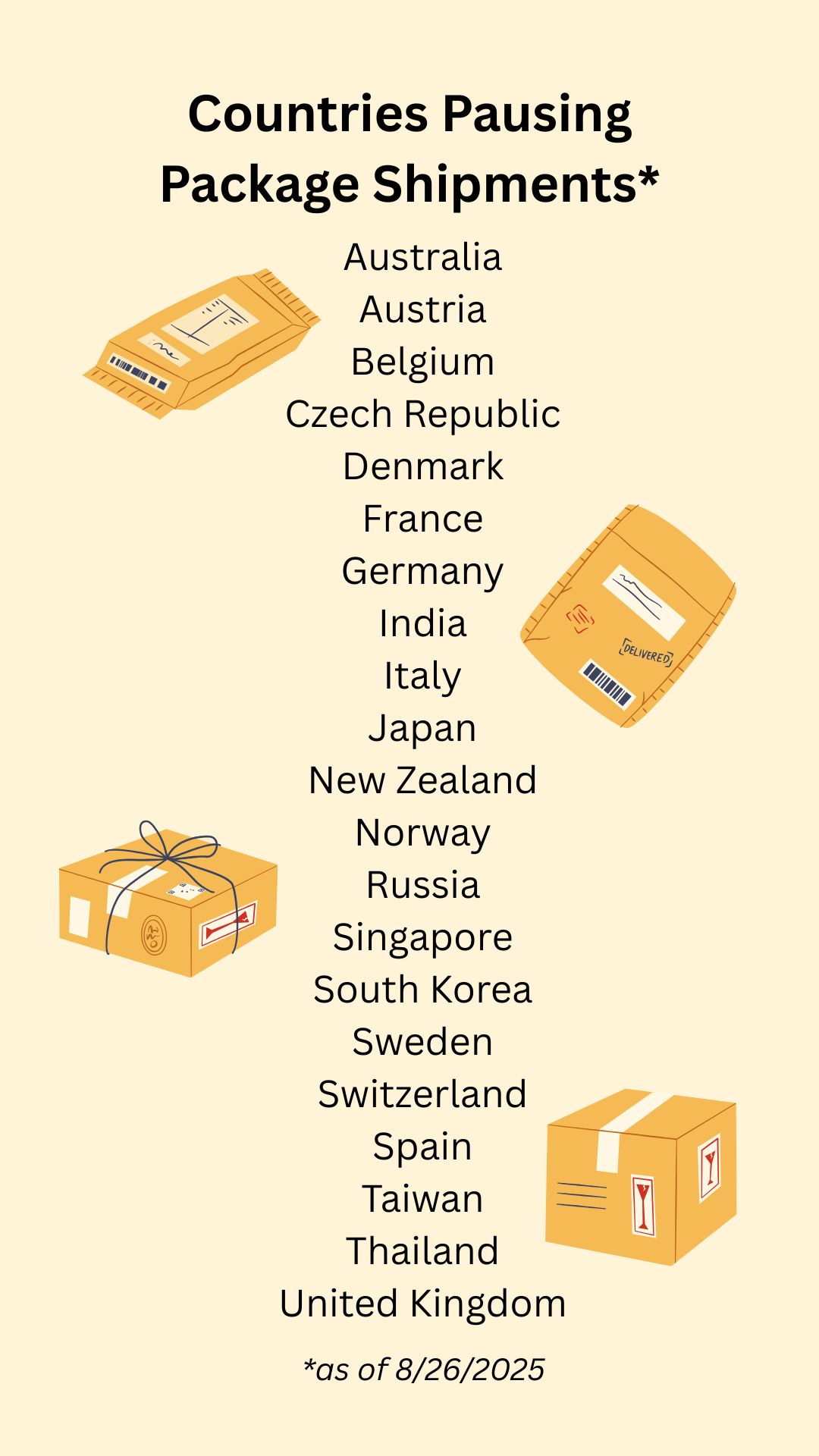
The foreign postal services’ pause on packages may or may not affect books shipped by small or indie sellers; that’s not clear yet. Since books are exempt from the tariffs, my best guess is that packages containing used or new books and nothing else will still be able to be mailed from, say, the UK or South Korea to the US. But I don’t have confirmation on that.
Higher costs for you
Speaking of fees (tariffs), those costs will eventually be passed along to you, the buyer. Depending on the country of origin, you could pay as much as 10% to 50% of the item’s cost in fees…and possibly more, because the seller will have to cover the additional time and inconvenience of filling out the necessary paperwork.
“Purchases that previously entered the U.S. without needing to clear customs will require vetting and be subject to their origin country’s applicable tariff rate, which can range from 10% to 50%. For the next six months, carriers handling orders sent through the global mail network also can choose a flat duty of $80 to $200 per package instead of the value-based rate.” — AP
Delivery delays
There’s another problem, and it’s one that most media coverage of this topic has barely mentioned, if at all. U.S. Customs and Border Protection simply doesn’t have the staff or infrastructure to inspect all the small parcels entering the US. Under de minimus, packages valued at under $800 were not inspected. And there were a lot of them—upwards of 4 million packages per day. Now that all those packages (or at least their paperwork) will have to be inspected upon entry into the country, you can expect huge delivery delays, at least until CBP is able to ramp up their processing capacity… or until the howls of outrage from angry consumers cause the administration to backtrack and restore the de minimus exemption, at least in part.
Short- and long-term impacts
While none of this is good news for buyers and sellers of bookish merchandise, the one bright spot for readers is that books themselves are exempt from tariffs… at least for now. According to the American Bookseller Association, “Because the Trump tariffs were imposed under the IEEPA, ‘informational materials,’ which includes books, are exempt. So there will be no additional tariffs on books sourced from any country, other than those which already existed.” (There have been tariffs on books printed in China since the first Trump administration.) However, the same is not true for components of books, like paper, ink, and cardboard, so we can expect the price of physical books to increase.
For some creators and indie sellers of bookish merchandise, the end of de minimus and the widespread pause in shipments may mean the end of their business. The US is a major market; we buy a lot of stuff. I have seen several creators saying on social media that US buyers make up 30% to 70% of their sales. Losing that market, even temporarily (due to the shipping pause in many countries), may drive some of them out of business.
For US consumers, it means that even after package shipping resumes, book-related items like stickers, buttons, bookmarks, and art from outside US will take longer to arrive, and cost more. Depending on where the seller lives, they could cost significantly more. (That’s true of other items, as well; I’m bracing for the cost of yarn to climb significantly.) Since those items may rely on paper, sticker blanks, button blanks, and plastic sourced from outside the US, even bookish merch printed in the US may increase in price.
If you buy books from retailers outside the US like Blackwell’s, or subscription boxes from Canadian-based Owlcrate or UK-based Fairyloot, you’re probably OK, at least as long as the book exemption remains in force. As of Thursday, 8/28/2025, Blackwell’s website still indicates they are shipping to the US (for free, by the way.) I confirmed this by reaching out to them through an Instagram DM. Both Owlcrate and Fairyloot have distribution centers in the US, so they can ship the books in bulk, then package them in the subscription boxes and mail them within the US. (The cost of their subscription boxes may go up if the included “extras” are subject to tariffs, though.)
What you can do
- For books, use the library. Although everything seems poised to become more expensive, the public library is still free! Bonus: the more people use their local libraries, the more likely those libraries are to retain their funding. Also, show up at board meetings and town halls for your local government, and let them know you support the library.
- Buy local. Support local bookstores, authors, and artists. They may have to raise their prices if the cost of their materials or supplies increases due to the tariffs, but by buying local, you at least avoid the tariff costs on the finished product. Plus, it helps people and businesses in your community, and that’s going to be increasingly important if the administration’s policies send us into a recession.
- Support independent bookstores and creators. If you’re buying online, try to support independent authors, artists, and bookstores in the US. They will have a harder time weathering the impacts of tariffs and the loss of de minimus than the giant retailers and bestselling authors will. Bookshop.org is a great place to buy physical books, and they now sell ebooks as well. You can also support indie authors and artists living outside the US if they their work is available through a US company.
- Check where your purchase will ship from, to avoid surprise duties or fees. Some retailers include this information on the order page, if you look hard enough. (Amazon does; so does Etsy.) Ebay and Etsy let you limit what you see to US shippers only, or only North America. (But be aware that many items from Canada or Mexico will have tariffs.)
- To help creators outside the US who are facing revenue loss, subscribe to their Patreon. Or buy them a Ko-fi. And buy their work if it’s available in the US (digitally for books, and through US-based firms like Redbubble or Teefury for art, stickers, t-shirts, etc.)
- And finally, contact your senators and congressional representative. Ask them to pressure the White House to restore the de minimus exemption, perhaps at the $200 level (or even $100.) There should be a way to restore the exemption to help US consumers and small businesses both domestic and foreign, while still addressing legitimate concerns over consumer safety and the deluge of low-cost, low-quality Chinese goods from Shein, Temu, and the like.
Sources
- This rule made many online purchases dirt cheap for U.S. consumers. Now it’s ending (NPR)
- More postal services pause shipments to U.S. with ‘de minimis’ loophole set to expire (NBC)
- Here’s why European postal services are suspending U.S. deliveries (USA Today)
- Map Shows Countries Suspending Postal Service to United States (Newsweek)
- A US tariff exemption for small orders ends Friday. It’s a big deal to some shoppers and businesses (AP)
- ‘De minimis’ loophole is ending; here’s what it means for online orders (Washington Post)
- An Overview of the 2025 Tariffs (American Bookseller Association)
- What shoppers can do to limit charges once the US ends a tariff exemption for goods under $800 (AP)















Anne - Books of My Heart
Thanks for putting together an informational and thoughtful post on these changes
Anne – Books of My Heart recently posted…🎧 Can’t Get Enough by Kennedy Ryan #KennedyRyan #WesleighSiobhan #JakobiDiem @grandcentralpub.bsky.social #LoveAudiobooks
Lark_Bookwyrm
Thank you; I hope it was helpful.
Nicole @ BookWyrmKnits
Ugh. I don’t like that you needed to explain this, but thank you for doing so!
Nicole @ BookWyrmKnits recently posted…Debts of Fire readalong ~ week four
Lark_Bookwyrm
I hope it was helpful! I don’t think most Americans have any idea how badly the tariffs are going to bite us all — let alone the loss of much of the agricultural and meat processing workforce. Fortune Magazine quoted some agricultural economists suggesting that the cost of dairy and produce will go up between 50% and 100% percent in six months. Eep.