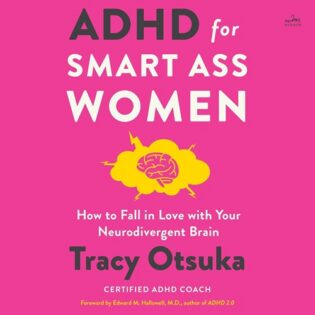
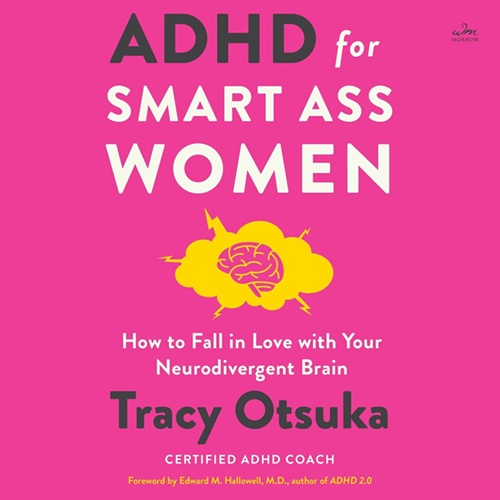
 ADHD for Smart Ass Women: How to Fall in Love with Your Neurodivergent Brain by Tracy Otsuka
 Narrator: Tracy Otsuka
Published by HarperCollins on 12/26/2023
Genres: Psychology, Nonfiction, Self-Help
Format: Audiobook
Source: the library (Hoopla)
Purchase: Amazon | Bookshop | Barnes & Noble | Kobo | Audible | Chirp
Add to Goodreads

An unprecedented guide for any woman with ADHD looking to celebrate her unique brilliance and to embark on a journey of self-discovery. Read by author Tracy Otsuka.
ADHD is one of the most common neurological disorders in the United States—yet a staggering 75 percent of girls and women remain undiagnosed. Due to the gender gap in medical research, which does not account for symptoms manifesting differently in women—leading to increased problems with anxiety, depression, working memory, sleep, energy, and concentration—many ADHD women are left to navigate a society that fails to understand their struggles and gifts. But what if every woman had the resources and support to uncover the hidden wonders of her neurodivergent brain?
Enter certified ADHD coach and podcast host Tracy Otsuka. Armed with her experience coaching thousands of women, cutting-edge medical research, and personal insights from her own diagnosis, she presents a revelatory guide tailored specifically for girls and women with ADHD. In it, Otsuka offers an entirely new set of tools, systems, and strategies to access a world of boundless productivity, focus, and confidence.
With her signature wit and levity—in entertaining chapters designed for ADHD readers—Otsuka explores the unique challenges that ADHD women face and illuminates the extraordinary qualities that set them apart: overflowing creativity, laser-focused attention, deep empathy, and fearless entrepreneurial spirit. Even without an official diagnosis, readers will be equipped with the tools to conquer any to-do list and to tap into their true purpose, personally or professionally.
By dismantling the long-standing stereotypes and misinformation surrounding women with ADHD, Otsuka offers a beacon of hope for any woman looking to transform her symptoms into strengths. Comprehensive, lively, and long overdue, ADHD for Smart Ass Women is the key to unlocking unparalleled potential and to understanding your truly magnificent and brilliant brain.
Are you ready to discover your superpower?
Supplemental enhancement PDF accompanies the audiobook.
How to Fall in Love with Your Neurodivergent Brain?
The title of Tracy Otsuka’s book, ADHD for Smart Ass Women: How to Fall in Love with Your Neurodivergent Brain, grabbed me from the start. I’m a reasonably intelligent woman who has struggled with ADHD symptoms much of my life, with all the attendant shame and guilt. My symptoms became much worse with late perimenopause and then menopause, which is common because estrogen mitigates the symptoms; today, I struggle even more. So I was excited to see what could be positive about having ADHD.
There is some very good information in the book, and several actionable suggestions. I definitely want to reread those sections with my eyes instead of my ears, take notes, and try some of them out. But I did struggle to relate at times. Otsuka’s experience as a successful woman with ADHD is very different than my own experience as someone who never really “succeeded” professionally (at least financially), and that made it harder for me to see myself in the book. Although I was reasonably good at the various jobs and hobbies I did throughout my life, I never made much money, and my focus was mainly on my husband and daughter rather than my career.
More than that, Otsuka’s frequent references to women with ADHD struggling in school and getting in trouble were completely foreign to me. I excelled all the way through high school (the only exception being the single course I took independently, which I failed for lack of deadlines and accountability.) And I was never a risk-taker or rule-breaker. It wasn’t until college that I ran into academic difficulties. Although my grades in college weren’t as good as in primary and secondary schoool, I managed to get by, mainly because I was smart, had a good educational foundation, and figured out ways to study that worked for me.
Additionally, as an introvert who falls more on the dreamy, “inattentive” side of ADHD, I had such a hard time relating to enough of Otsuka’s descriptions of ADHD in (hyperactive, extroverted) women like herself that at times I found myself wondering despondently if I really do have it. Fortunately, I have done enough reading in the field to feel pretty confident that the answer is yes.
Despite those quibbles, I do plan to revisit the book with a highlighter, notebook, and journal in hand, to get the most I can out of Otsuka’s positive suggestions. But I’m not going to take her book as my sole source of information and inspiration, and I don’t recommend anyone else do so, either—especially if you fall more in the inattentive type than the hyperactive side. I did appreciate that Otsuka points out over and over that many ADHD traits can be viewed positively, rather than negatively, and that people with ADHD usually have a number of strengths. I look forward to figuring out my own strengths, but I also need to find ways to compensate for or work around my challenges. Otsuka offers a few ideas on that, too, including treatment approaches that don’t involve medication. (I hasten to add that she has nothing against medication, and neither do I. However, there are reasons why medication may not be right for me.)
Is this book right for you? I think if you are looking for a book to inspire you to view your ADHD through a positive lens, this is a great place to start. However, if you think you might have ADHD, but you’re not sure, I feel that Otsuka doesn’t spend enough time on the wide variety of ADHD symptoms in women, especially introverted women with the inattentive type. Instead of starting here, read up from a variety of sources on how ADHD manifests in girls and women, and see if those symptoms resonate with your experience. If they do, consider seeking a diagnosis (as Otsuka herself suggests several times.) Then read the book for encouragement, ideas, and a positive spin on how to “fall in love with your neurodivergent brain.”
Challenges: Audiobook Challenge 2026; COYER 2026: Out to Lunch Again; Library Love Challenge 2026
Reading this book contributed to these challenges:
- Audiobook Challenge 2026
- COYER 2026: Out to Lunch Again
- Library Love Challenge 2026



























Sarah @ Sarah's Book Solace
I’m with you. A later–in-life diagnosis with ADHD was difficult because I didn’t have all those “struggling in school” markers. In fact, I was always pretty good at school (and I just got my Master’s, etc.). Might have to give this one a read. Thanks for the review!
Sarah @ Sarah's Book Solace
Yeah, my ADHD doesn’t really present that way either. I did exceptionally well in school. It was really in college where I struggled. Though not in classes, just to focus enough to get all my work done and I struggled a lot with indecision.