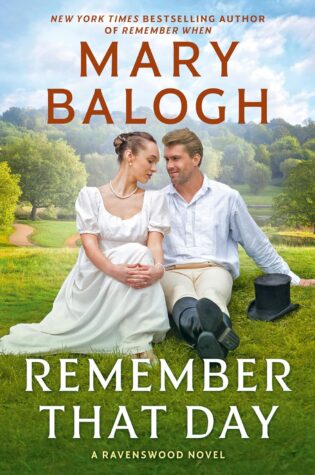
 Remember That Day by Mary Balogh
 Series: Ravenswood #5
Published by Berkley on 1/06/2026
Genres: Historical Romance
Format: Kindle or ebook
Source: purchased
Purchase: Amazon | Bookshop | Kobo | Audible | Chirp
Add to Goodreads

Also in this series: Always Remember
Also by this author: The Proposal, The Arrangement, The Escape, Only Enchanting, The Heart of Christmas, Christmas Gifts, Christmas Miracles, Only a Promise, Someone To Love, Someone to Hold, Someone To Honor, Always Remember
A soldier and a pacifist make the unlikeliest of pairs, but when attraction sparks, there’s nothing that can prevent their love from igniting.
Winifred Cunningham, the adopted daughter of a portrait painter, hopes that her new close friend, Owen Ware, will soon ask for her hand in marriage. But when Owen introduces Winifred to his elder brother Nicholas, the late Earl of Stratton’s second son, the slow burn of attraction between them begins.
Nicholas is a cavalry colonel—a hardened soldier whom Winifred at first despises. She finds him intimidating and cruel-looking, while he finds her strange and startlingly forthright. During a summer at Ravenswood, however, Nicholas and Winifred are unwillingly thrown together on several occasions, until they realize the passion that drives their disagreements is not due to dislike—it is because of attraction.
Winifred still awaits Owen’s proposal, and Nicholas has made his intention to marry his commanding officer’s daughter quite clear. With allegiances to other marriage prospects and brotherly bonds at risk, not to mention the age difference between them, Nicholas and Winifred know it would be wholly improper to pursue a romance...
And yet, romance is irresistible. Perhaps even inevitable.
Opposites attract
Nicholas Ware is 34, the brother of an earl, handsome and charming, and a career soldier. Winifred Cunningham is 21, a foundling, plain, and a pacifist. Nicolas is all but engaged to the daughter of his commanding officer; Winifred harbors hopes of a betrothal to her good friend Owen Ware—Nicholas’s younger brother. Marriage between them is obviously impossible. Isn’t it?
Normally, I’m not comfortable with romances between people who are already involved with someone else, unless they are well-written, don’t involve actual cheating, and the prior relationships are resolved appropriately before the main couple get together. I trust Mary Balogh, though, to handle such a situation sensitively and well, and she does just that in Remember That Day.
I love both Nicholas and Winifred as characters. Balogh reveals their complexities and hidden wounds slowly, and their internal growth, particularly Nicholas’s, is lovely to see. As a longtime fan of Ms. Balogh’s books, I was already familiar with both characters: Winifred is the adopted daughter of the couple in Someone to Hold (Westcotts #2), and the prior books in the Ravenswood series, of which Remember That Day is #5, have been about Nicholas’s siblings and mother. The two of them are an unlikely but ultimately believable pairing, and I really enjoyed watching the slow blooming of their relationship from initial wariness through avoidance, attraction, and finally love.
If you haven’t read any of the previous books, it can be a little challenging to keep track of the many secondary characters in the extended Ware and Westcott families, but Balogh makes it as easy as possible given the large-ish cast. There’s also a handy guide to the families in the back, complete with family trees. For me, it was a chance to catch up with some familiar faces. I loved seeing Winifred’s parents, Camille and Joel Cunningham, almost a decade into their marriage, along with their adopted and biological children. Nicholas’s delightful brother Owen gets more page time than in previous books, and there are also hints of a future romance for the youngest Ware sibling, Stephanie, now 25. (For her romance, see A Waltz to Remember, coming in October.)
Mary Balogh has been one of my auto-buy authors for years. I love her romances, which are written with sympathy toward and a deep understanding of her characters. I also appreciate her narrative voice, which evokes something of the more formal writing of the early-to-mid-19th century without sacrificing any of the warmth, longing, and love I look for in a historical romance. And for the most part, her books feel well-grounded in the period; you rarely come across glaring anachronisms or obvious historical errors. There was, alas, one rather distressing exception in this novel, with regards to a secondary character’s disability (see discussion below.) Setting aside that one disappointment, however, I loved the rest of the book, and will probably revisit it in a series re-read at some point. And I’m very excited for the next book in the series, A Waltz to Remember.
Challenges: COYER 2026: Out to Lunch Again

Historical inacuracy: I found one of Ms. Balogh’s historical assumptions quite troubling. Winifred’s adopted sibling Andrew is profoundly deaf. Twice in the book, Winifred states or thinks that Andrew cannot speak, read, or write because of his deafness. In fact, he cannot communicate except through basic gestures or a rudimentary sign language Winifred devised. This assumption seems to be shared by all the other characters—or at least, no one ever challenges it, including Camille and Joel Cunningham, Andrew’s adoptive parents. But it’s simply not true that the deaf can’t learn to read and write, and that wasn’t a new idea even in the early 19th century. As far back as the 17th century, there were writers and scholars who advocated teaching the deaf to lipread, read and write, and/or use a signed alphabet to communicate.1 In Balogh’s earlier novel Someone to Hold, Camille Westcott (now Winifred and Andrew’s adoptive mother) taught in an orphanage for a few months. During that time, she was very inventive in coming up with ways to teach and engage children. I couldn’t believe that Camille and Joel hadn’t researched and tried various methods of teaching Andrew to read and write as a means of communication; it seems so obvious that they would. But there’s no indication that they have tried and failed, merely an acceptance of deafness as a barrier. As someone who grew up practically next door to my deaf cousin, I was both disappointed and dismayed—not so much in or by the characters as Ms. Balogh. I suppose it’s possibly the author may be relying on her research for Silent Memory, her 1997 Georgian romance about a deaf heroine, which I have not read. Nonetheless, today it takes no more than a quick Google search to discover that although some deaf people were institutionalized, particularly among the upper classes, many learned to communicate in some manner (including reading and writing), worked in the hearing community, and in some cases, married and had families. The belief that Balogh’s characters have concerning deaf people’s ability to read and write was far from universal at the time, and seems particularly out of character for Camille, Joel, and Winifred. I wish that Balogh had double-checked her assumptions, and failing that, that her editor or copyeditor had flagged this for revision.
- Wilks, Rachel Charlotte, Aspects of Deafness in 18th Century Britain, p. 154. Found in Cronfa, Swansea University’s searchable repository. ↩︎
About Mary Balogh
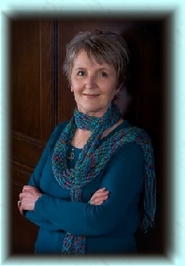
Mary Jenkins was born in 1944 in Swansea, Wales (UK.) After graduating from university, she moved to Saskatchewan, Canada, to teach high-school English in 1967. She married her Canadian husband, Robert Balogh, and had three children, Jacqueline, Christopher and Sian. When she’s not writing, she enjoys reading, music and knitting. She also enjoys watching tennis and curling.
Ms. Balogh started writing in the evenings as a hobby. Her first book, a Regency love story, was published in 1985 as A Masked Deception under her married name. In 1988, she retired from teaching after 20 years to pursue her dream to write full-time. She has written more than seventy novels and almost thirty novellas since then, including the New York Times bestselling Slightly sextet, the Simply quartet, and the Huxtables series. She has won numerous awards, including a Romantic Times Lifetime Achievement Award. 37 of her novels have been NYT bestsellers.
Reading this book contributed to these challenges:
- COYER 2026: Out to Lunch Again























Leave a Reply